

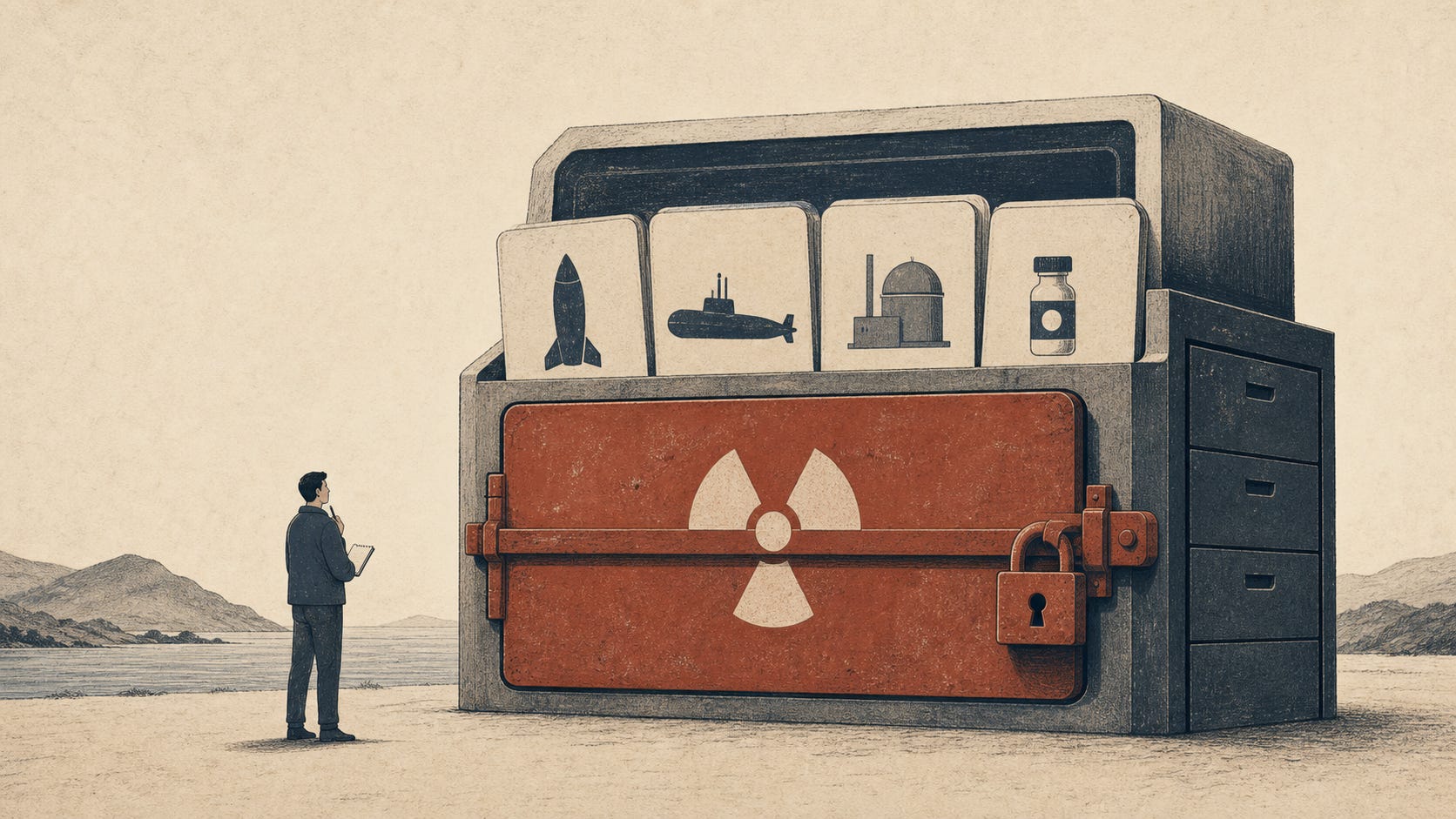
When Chris Penk said New Zealand should be able to discuss the difference between nuclear weapons and nuclear propulsion, he was not announcing a policy change.
He said there was no official or unofficial shift in New Zealand's nuclear-free position. The specific point was narrower: Australia's AUKUS submarines are nuclear-propelled, not nuclear-armed, and there may be value in the country understanding that distinction.
That should have been a fairly normal thing for a Defence Minister to say.
In New Zealand, it was not.
The discussion immediately snapped back to the familiar frame. Was National softening our nuclear-free stance? Would nuclear-powered vessels be allowed here? Was this a threat to the identity New Zealand has held since the 1980s?
Luxon's office quickly said the policy would not change. Chris Hipkins said Labour would "never change" New Zealand's nuclear-free status. A commentator in the same story warned that Pacific and South East Asian partners would be alarmed if New Zealand started backtracking on rejecting nuclear power "in all its facets".
This is not a National problem or a Labour problem. It is the incentive structure around the word itself.
That phrase is the whole problem.
"Nuclear power in all its facets."
Weapons, propulsion, medicine, research, electricity, waste, testing, submarines, uranium, bombs, reactors, geopolitics, Pacific history, national identity. One word stretched across too many different things.
The specific question disappeared into the category.
That is what this post is about.
If that feels like a strange subject for this publication, fair enough. I usually write about AI, founders, software, and what it means to build from New Zealand. But over the last few months, the AI story has become an electricity story. The companies trying to build frontier models and hyperscale data centres are suddenly talking about power supply, grid constraints, and firm clean electricity. That pulled nuclear back into my reading stack.
That does not mean New Zealand should copy the United States or China. We do not have the capital, compute base, grid scale, or industrial machinery to compete in frontier model training or hyperscale AI infrastructure. But when AI pulls a decades-old energy debate back into live global conversation, it is worth checking whether our own decades-old policy frame still makes sense.
I am not arguing New Zealand should build a nuclear power station. It may be wrong for us on cost, consenting, regulation, seismic risk, grid fit, or simply because the alternatives are better.
The claim is narrower: if the answer is no, it should be no because the engineering and economics do not work. Not because the word makes everyone flinch.
The original stance was serious
The lazy version of this argument is to say nuclear just has a PR problem.
That is wrong.
New Zealand's nuclear-free position was not a random public panic about technology. It came out of a real historical moment.
Pacific nuclear testing was not abstract. The South Pacific was used by large powers as a place to test weapons they would never have tested at home. The Treaty of Rarotonga was rooted in that experience. The US neither-confirm-nor-deny policy meant New Zealand was asked to accept ships without knowing whether they carried nuclear weapons. The ANZUS rupture was real. The Rainbow Warrior bombing was real.
For New Zealand, nuclear-free became more than a policy. It became a statement about sovereignty, Pacific solidarity, and not being pushed around by bigger powers.
That deserves respect.
If you ignore that history, you will not bring the country along. You will just sound like someone who discovered small modular reactors on the internet last week and thinks everyone else is stupid.
They are not.
The public reaction exists for reasons.
But the fact a reaction has roots does not mean it should remain unexamined forever.
Nuclear-free was the right answer to a weapons question. It has become an overloaded answer to every question containing the word nuclear.
That is the category error.
Nuclear is not one thing
The simplest way to explain nuclear power is this: most power stations are complicated kettles.
You make heat. The heat boils water. The steam spins a turbine. The turbine makes electricity.
Coal burns coal to make the heat. Gas burns gas. Geothermal uses heat from the earth. Nuclear uses heat released from splitting atoms.
That process is called fission. It is not the same thing as a nuclear bomb. A bomb is designed to release energy all at once. A nuclear power station is designed to release heat slowly, control it, and use it to make electricity.
Even inside nuclear energy, there is not just one technology.
The big plants most people picture are light-water reactors, many built from the 1960s through the 1980s. They are powerful and can run for decades, but they are expensive, slow to build, and require serious engineering and regulatory capability.
More modern large reactors improved the same basic model with better materials, better control systems, better containment, and more safety layers.
Small modular reactors are a different attempt again. The idea is smaller reactors, with more of the plant built in factories and assembled on site, rather than every project becoming a giant one-off construction exercise. The promise is lower upfront cost, shorter build times, easier financing, and a better fit for smaller grids or industrial users.
The catch is that most commercial SMRs still have to prove themselves at scale.
Then there are advanced reactors, using different coolants and fuels: molten salt, gas, liquid metals, TRISO fuel, industrial heat applications, hydrogen, desalination, data centres. Some of this will work. Some of it will not. That is true of every serious technology field.
And then there is fusion, which is different again.
Fission splits atoms. Fusion joins light atoms together, more like what powers the sun. Fusion is still not a commercial electricity source, and it may stay "nearly there" for longer than its backers want to admit. But it is not science fiction anymore.
New Zealand has a local example. OpenStar Technologies, based in Wellington, is building a levitated dipole fusion reactor. In late 2024, OpenStar created plasma at 300,000 degrees Celsius for 20 seconds, according to government papers on the Regional Infrastructure Fund investment. In February 2026, World Nuclear News reported that OpenStar publicly demonstrated creating and confining plasma using a levitated dipole reactor, floating a half-tonne magnet inside plasma. The Government has since backed the company with up to $35 million through the Regional Infrastructure Fund for a specialised fusion R&D facility.
OpenStar does not prove fusion will work, and it says nothing about whether New Zealand should build fission reactors. The Royal Society's write-up is careful to note that the machine is not yet producing more energy than it consumes.
But OpenStar does prove something relevant to this argument: even inside New Zealand, "nuclear" is already more varied than the public debate admits.
These are not all at the same stage. Existing fission reactors are infrastructure. SMRs are early commercial infrastructure. Fusion is still research.
The point is not that modern nuclear is magically solved.
The point is that it is not honest to talk as if nuclear power technology stopped in 1987.
The world has reopened the question
New Zealand still talks about nuclear as if the world has already settled it.
It has not.
The International Energy Agency says nuclear produces just under 10% of global electricity and is the second-largest source of low-emissions electricity after hydro. Its Electricity 2026 report says nuclear generation set a new record in 2025 and is expected to keep rising through 2030.
The IEA's nuclear overview describes a global fleet of nearly 420 active reactors. Its 2025 electricity review said 62 reactors were under construction as of February 2025, representing nearly 70 gigawatts of capacity, with China accounting for nearly half of global nuclear capacity under construction.
More than 40 countries now have policies supporting nuclear expansion.
That does not mean they are all right. It does mean the question is live.
The demand story has changed too. Big technology companies are now buyers of firm clean power. Microsoft and Constellation are trying to restart Three Mile Island Unit 1 to supply clean electricity. Google signed a deal with Kairos Power for advanced nuclear power. Amazon has backed X-energy and Energy Northwest for small modular reactors.
The New Zealand implication is not "copy the AI data-centre race." It is simpler: serious buyers of reliable clean electricity are looking at nuclear again.
The world is not becoming unanimously pro-nuclear. Germany closed its last reactors. Australia is fighting a deeply political argument over sites, cost, and timing. Large projects in the West still have a bad habit of running late and over budget. The Vogtle units in Georgia finally entered service in 2023 and 2024, but only after years of delay and huge cost overruns. NuScale's Idaho SMR project was cancelled in 2023.
The honest version is more interesting than either slogan.
Nuclear is not dead. Nuclear is not solved. The world has reopened the question.
New Zealand should at least be able to notice that.
Our energy problem is specific
New Zealand does not need this conversation because our electricity system is dirty.
It mostly is not.
MBIE says 85.5% of our electricity generation came from renewables in 2024. That is a strong position by global standards.
The problem is the remaining part.
In 2024, low hydro inflows and lower gas supply pushed more generation back toward coal. MBIE says coal generation rose 118% to 2,243 GWh. That is the weakness of a high-renewables system with a large hydro base: when the lakes are low and demand is high, the backup still matters.
Electrification will make that harder. Cars, process heat, industry, homes, and perhaps some data-centre load at the margin. More of the economy will run on electricity. That is good, but it means the grid needs more generation, more flexibility, and more firm capacity.
I wrote in Software Doesn't Ship Through the Strait of Hormuz that New Zealand is too exposed to physical systems we do not control. Fuel, shipping, fertiliser inputs, export routes. Electricity sits inside that same vulnerability story. A country at the edge of the world should be very interested in resilient domestic energy.
The alternatives are real: geothermal, wind, solar, grid batteries, household batteries, EVs, hot-water control, demand response, transmission upgrades, pumped hydro, renewable fuels, and probably some uncomfortable gas conversation along the way.
The Electricity Authority makes an important distinction between winter peak capacity and dry-year risk. Batteries can help with peaks. They do not automatically solve multi-week or multi-month shortages when hydro inflows are low.
So the adult question is not "nuclear or coal?"
It is: what mix of firm, flexible, low-emissions capacity does New Zealand need as demand rises, and what should be in scope when we test the options?
Nuclear may lose that comparison quickly. New Zealand's grid is small, and a large reactor would be a very large single asset inside it. SMRs partly answer that on paper, but not yet with proven fleet economics.
But technology does not stop. A 2026 comparison is not a 2046 comparison. Solar, wind, geothermal, batteries, demand response, and transmission upgrades may be the better answer for New Zealand now, and may remain the better answer for a long time. The point is that we should be able to update the comparison as the technology changes, rather than treating the 1987 mental model as permanently settled.
That is exactly why it should be compared, not excluded before the comparison begins.
The accidents matter
The three accidents everyone reaches for are Three Mile Island, Chernobyl, and Fukushima.
They are usually talked about as one thing: nuclear meltdown.
They were not one thing.
Three Mile Island was a partial meltdown in a pressurised water reactor. A valve got stuck open. Cooling water escaped. The instruments did not make the problem clear. Operators misread the situation and took actions that reduced cooling to the core. The reactor was badly damaged, but containment largely worked and off-site radioactive releases were small.
That was not "nuclear technology inevitably fails". It was bad instrumentation, bad procedures, equipment failure, and confused humans turning a manageable failure into a serious one.
Chernobyl was the outlier. A dangerous Soviet RBMK reactor design, unstable operating conditions, flawed control rods, safety systems disabled or bypassed, a badly run test, and a secretive political system. Design failure, operator failure, and institutional failure all at once.
Chernobyl is a case for taking design, transparency, and safety culture seriously. It is not a clean proxy for every reactor built since.
Fukushima is the one New Zealand has to sit with.
The reactors shut down after the earthquake, as they were meant to. The problem was cooling after shutdown. Nuclear fuel keeps producing decay heat. It still needs cooling. The tsunami flooded backup generators and electrical systems. With power gone, cooling failed, fuel melted in Units 1, 2, and 3, and hydrogen explosions followed.
Fukushima was not a reactor running out of control. It was a cooling and backup-power failure after an extreme natural event that had been underestimated.
That is highly relevant here.
New Zealand sits on a plate boundary. We have major earthquake risk, tsunami risk, volcanic risk, flood risk, coastal exposure, and long thin infrastructure. Any serious nuclear conversation here has to start with that reality, not treat it as a footnote.
That does not mean every site has the same risk, or that seismic risk automatically rules nuclear out. It means site selection and emergency planning would be the first-order question, not an appendix.
The question would not be "is nuclear safe in theory?"
It would be: where could a plant go that is not exposed to unacceptable earthquake, tsunami, volcanic, flood, coastal erosion, or sea-level risk? Can backup cooling and emergency power survive the same event that knocks out roads, transmission, and local infrastructure? Who regulates it, given New Zealand has no civilian nuclear power regulator and no operating industry? What happens if the plant is fine but the surrounding region is damaged and unreachable?
Those are not anti-nuclear questions.
They are the questions you ask if you are taking nuclear seriously.
The lesson from the big nuclear accidents is not that nuclear can never be safe. The lesson is that nuclear demands boring excellence: conservative design, honest regulation, clear instruments, trained operators, transparent reporting, emergency planning, and institutions that do not lie to themselves.
That is why this is not just a technology question.
It is an institutional competence question.
The law is narrower than the slogan
This is the part I suspect many people have wrong, and I want to be careful because I am not a lawyer.
As I read it, the New Zealand Nuclear Free Zone, Disarmament, and Arms Control Act 1987 does not simply say "no nuclear energy, ever".
It establishes the New Zealand Nuclear Free Zone. It prohibits nuclear explosive devices. It prohibits biological weapons. It bans ships whose propulsion depends wholly or partly on nuclear power from entering New Zealand internal waters. It implements parts of our non-proliferation and South Pacific nuclear-free commitments.
Those are serious rules.
But they are not the same as a blanket statutory ban on land-based civilian nuclear electricity generation.
That does not mean a nuclear power plant would be easy to build here. It almost certainly would not be. We would need a regulatory regime, consenting, radiation safety approvals, emergency planning, waste arrangements, site security, grid connection, insurance, decommissioning plans, skilled operators, and probably new legislation or institutional machinery.
The important point is simpler.
The public slogan is broader than the law.
We talk as if "nuclear-free" already answers questions it may not legally answer at all.
That should bother us.
What serious leadership would look like
Politicians should be able to raise this without being treated as if they are secretly trying to park a nuclear submarine in Wellington Harbour.
That does not mean they should announce reactors.
Australia is a useful warning here. Once nuclear became an election policy, complete with proposed sites, it went straight into the usual culture-war machinery. Cost, timing, community consent, climate policy, renewables, NIMBY fights, party identity. It may have been inevitable there, but it is not a model to copy.
Singapore is more interesting.
It has not decided to deploy nuclear energy. Instead, it is studying advanced nuclear technology, building technical expertise, learning from international partners, and preparing for an IAEA review in 2027 so it can understand what an informed decision would require.
That is the distinction New Zealand needs.
Exploring is not endorsing. Studying is not building. Understanding an option is not the same as choosing it.
A serious New Zealand process could start with a plain-English explainer separating nuclear weapons, nuclear propulsion, nuclear medicine, nuclear research, nuclear electricity, and nuclear waste.
Then commission an independent review of firm clean power options: geothermal, wind, solar, storage, demand response, transmission, pumped hydro, renewable fuels, gas, and nuclear. Put them in the same frame. Compare them honestly.
Ask the IAEA what New Zealand would need to know before even considering nuclear electricity, not because we have decided to build anything, but because we should understand the institutional gap.
Run a seismic and site-screening study that might conclude there are no acceptable sites.
Invite Pacific partners into the framing early, especially on weapons, testing legacy, waste, and Treaty of Rarotonga concerns.
Make the first decision a decision to understand the question properly.
That is not radical.
That is how an adult country thinks.
AI will need the same discipline
This is the part that brings the argument back to the usual territory of this publication.
New Zealand is already at the start of the same kind of framing problem with AI.
The Government published New Zealand's first AI Strategy in July 2025. It is deliberately focused on practical adoption rather than high-end model development, which I think is directionally right for a country our size. The strategy itself says New Zealand is taking a light-touch, principles-based approach, using existing privacy, consumer protection, human rights, and other technology-neutral frameworks that can be updated when needed.
That is a reasonable starting point.
Some of the harder AI policy questions are already live, and more are coming. Public-sector automation. Automated decisions with legal or financial consequences. Privacy. IP. Education. Procurement. Liability. Model transparency. Workplace displacement. Autonomous agents acting inside high-trust systems.
If we let "AI" become one overloaded category, we will repeat the nuclear mistake in a new domain.
A chatbot helping someone draft an email is not the same thing as an automated welfare decision. A coding assistant is not the same thing as facial recognition. A model summarising a meeting is not the same thing as an autonomous agent moving money. Frontier model training is not the same thing as a small NZ company using AI to reduce admin work.
Some uses should be encouraged. Some should be regulated tightly. Some should probably be banned. But we cannot decide that intelligently if the whole debate collapses into one moral reaction to the word AI.
This will only get harder as nuclear power, AI infrastructure, and space infrastructure start overlapping in ways our 1980s categories were never built to handle.
Nuclear is the warning. AI is the live test.
The political problem is the point
The obvious objection is that this is politically suicidal.
At present, it probably is.
That is exactly the problem.
If a politician cannot seriously raise the difference between nuclear weapons and nuclear propulsion without the system instantly snapping back to "are we changing nuclear-free?", then we do not have a nuclear policy. We have a taboo with legislation wrapped around it.
Taboos are useful for some things. They draw bright lines. They simplify hard choices. They protect values that should not be casually traded away.
But taboos are bad at second-order thinking.
They freeze categories.
They stop us asking whether the thing we are rejecting is still the thing we think it is.
In New Zealand's Three-Year Window, I argued that small countries have to move early when the world changes. We do not have enough scale to be complacent. That argument was about AI and founders, but the underlying point applies more broadly. New Zealand cannot afford to let inherited categories do our thinking for us.
This is not a call to abandon nuclear-free.
It is a call to remember what nuclear-free was for.
Keep the line on nuclear weapons. Keep the Pacific history in view. Keep the sovereignty argument. Keep the instinct that New Zealand should not be casually pulled into other countries' military machinery.
But stop using that history as an excuse to avoid every conversation that contains the same word.
A country that cannot discuss an option is not choosing against it.
It is avoiding the work of choosing.
And sooner or later, the world changes enough that avoidance becomes its own decision.
I'm Ben Lynch. I write about founders, AI, and what happens next from New Zealand. Say hello at ben@thinkdorepeat.ai.
If you're new here, Start Here is the best place to begin.
If you know someone who can separate the nuclear question from the nuclear reflex, send this to them.